
ALL IS FAIR IN LOVE AND METAPHOR By MariJean Wegert
“The secret is relatedness. Relatedness breeds love, and love can excavate conscience. Conscience changes the way we behave. Relatedness is how we wake up.” ~Martin Shaw, Courting the Wild Twin
ALL IS FAIR IN LOVE AND METAPHOR
One February, when I was in middle school, my seventh-grade teacher asked her students to write a definition of love while we were assigned to read the novel Love Story by Erich Segal instead of Beowulf.
Me and the single other nerdy writer-type in the class rolled our eyes, read Beowulf anyways, and scribbled out defiant definitions, which were tacked up onto the corkboard with the rest of the class. Most of them said a version of the same thing: love is a feeling.
“Love is not a feeling. Love is the byproduct of oxytocin neurotransmission,” she said.
“Love is not a feeling, said mine. Love is an action and commitment.”
My own answer was proudly procured from my spiritual lineage. However, despite my devoutness and commitment to this definition of love, I had a secret: I was drawn to the definitions of love in what I loved the most: my favorite stories.
In the stories I loved the most, love showed up differently every time.
In That Hideous Strength, the third and final book of C.S. Lewis’ mesmerizing space trilogy, the main character, Jane Studdock, her tidy, boring life as a housewife is rattled when she starts seeing and hearing voices in her head that warn her of future events. As she seeks out people who can help her with this strange affliction, she stumbles on a plot for world domination involving the reanimated head of a genius, aliens from the dark side of the moon, a lion-haired man who travels to the planet Venus and returns with a mysterious wound, and a secret society of rebels who resurrect Merlin the Magician from his grave.
Her boring housewife life isn’t so boring anymore. And it turns out that she has a role to play in all of it. At the end of the story, she hears a voice in her mind that invites her into St. Anne’s, an unassuming house at the top of a hillside where most of the plot-thwarting takes place. The voice tells her:
“Be glad thou sleeper and thy sorrow offcast,” the voice says. “For I am the gate to all good adventure.”
Of anything I loved about stories, it was this kind of adventure I was looking for. And, it turns out, the essence of love is a lot more like adventure than anything else.
“But that’s a metaphor,” you might say.
“And what if it is that, too? What if love is a metaphor?
“Metaphor” comes from the Greek word metaphorá, “to carry across.” Metaphor makes new connections: it is a gate, a channel. A good metaphor is a surprise: “I never thought about it this way before.”
A metaphor is born of a question: “What if this were like this?”
“But they’re not related,” we might say.
“What if they are?” Metaphor asks. A metaphor creates the possibility of a relationship. It’s born in the author's mind and invites the reader to relate.
So does love.
Love asks: “What is it like to be you? How can I support you? What do you need?”
Love asks, “How are we different?”
Love asks, “How are we alike?”
Love asks, “What are we creating together?”
Each question sets the field conditions for a new reality – one that connects, carries, and creates.
I became a writer because I loved relating things to each other. I loved metaphors like I loved a good adventure story. When Kurt Vonnegut wrote, “the giants walked and walked,” in reference to bombs crawling over the landscape of Dresden; when Ray Bradbury wrote, “How like a mirror, her face,” when Lemony Snicket wrote, “I will love you as misfortune loves orphans, as fire loves innocence, and as justice loves to sit and watch while everything goes wrong,” I felt something stirring in my body and spirit that the platitudes of my spiritual lineage did not awaken. The images my favorite authors penned were not just literary devices – they were creating something new, and I felt this newness in my body.
It wasn’t until many years later that I started realizing my hunch was right – when tarot reader and writer Jessica Dore quoted the philosopher Kelly Oliver, who defined love in her essay “Witnessing Subjectivity” as “an ethics of difference that thrives on the adventure of otherness.”
Then I discovered it in other disciplines, too. In Matter and Desire, An Erotic Ecology, Andreas Weber outlines how the nature of love is outlined in biology itself, in the resonant connections between beings. “Love is not a feeling,” he writes. “But the characteristic of a productive relationship.”
I discovered it in civil rights discourse, where oppressed people have been struggling to be heard and humanized for hundreds of years. In the documentary The Color of Fear, which addresses the deep honesty required to start to reckon with the harm of systemic racism, Victor Lee Lewis notes, “I'm not going to trust you until you’re as willing to be changed and affected by my experience, and transformed by my experience, as I am every day by yours.”
But most of all, I discovered the relationship between living and writing, whether a question or a quest, what was willing to relate was ready for adventure: “Real love alters participation,” writes artist and relational field facilitator Laura Geiger. “Real love is everything that the field conditions of colonial modernity cannot tolerate. It’s slow, inconvenient, unpredictable, and costly. It demands negotiation and risks being changed….I want [that] relational ecology. I want love that recognizes what it touches.”
I want love that recognizes what it touches, too. I want the adventure of it, and the intimacy of it.
I want love like a metaphor.
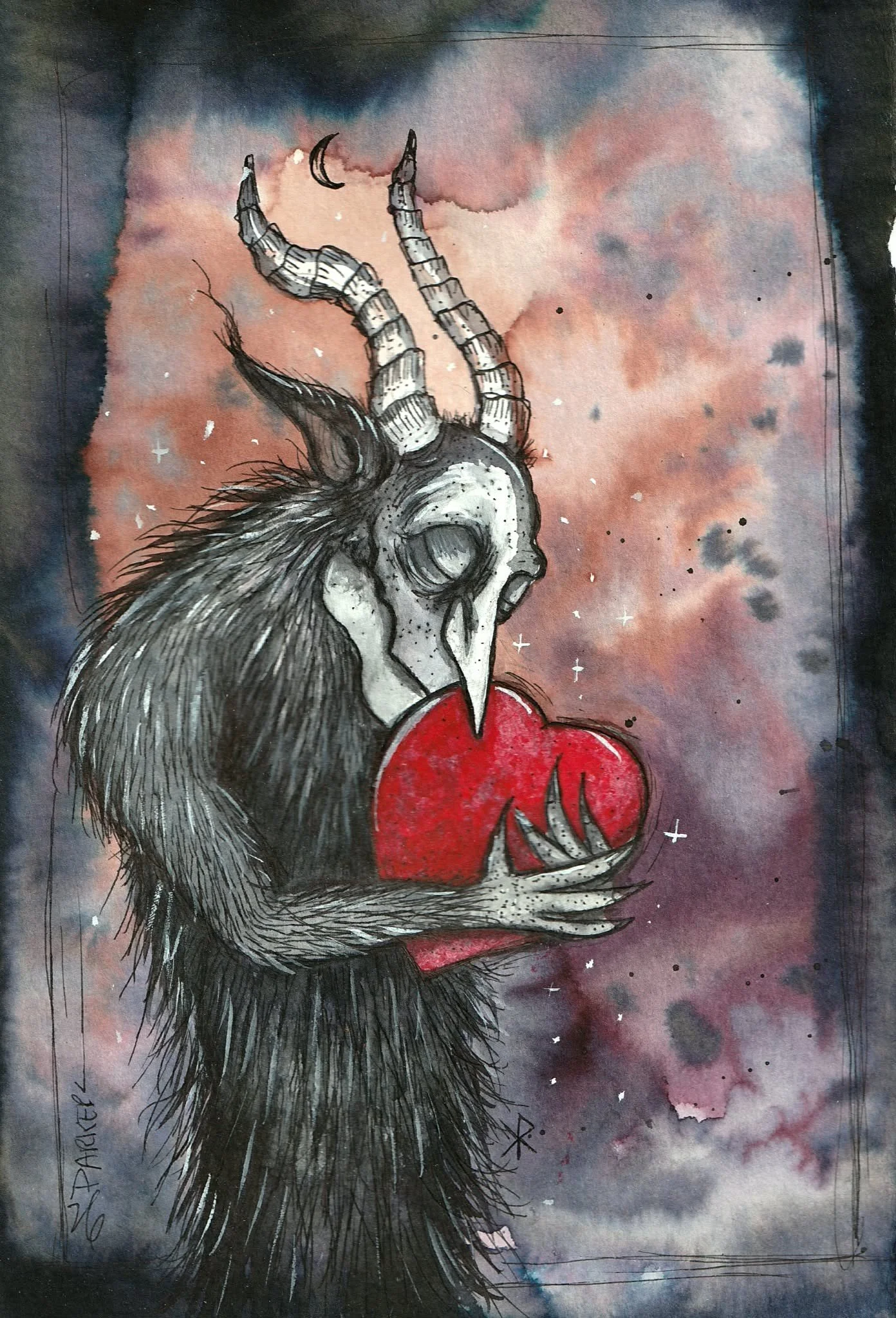
Art by Jeremy Parker at Wildwoods Workshop
estion: “What if this were like this?”
“But they’re not related,” we might say.
“What if they are?” Metaphor asks. A metaphor creates the possibility of a relationship. It’s born in the author's mind and invites the reader to relate.
So does love.
Love asks: “What is it like to be you? How can I support you? What do you need?”
Love asks, “How are we different?”
Love asks, “How are we alike?”
Love asks, “What are we creating together?”
Each question sets the field conditions for a new reality – one that connects, carries, and creates.
I became a writer because I loved relating things to each other. I loved metaphors like I loved a good adventure story. When Kurt Vonnegut wrote, “the giants walked and walked,” in reference to bombs crawling over the landscape of Dresden; when Ray Bradbury wrote, “How like a mirror, her face,” when Lemony Snicket wrote, “I will love you as misfortune loves orphans, as fire loves innocence, and as justice loves to sit and watch while everything goes wrong,” I felt something stirring in my body and spirit that the platitudes of my spiritual lineage did not awaken. The images my favorite authors penned were not just literary devices – they were creating something new, and I felt this newness in my body.
It wasn’t until many years later that I started realizing my hunch was right – when tarot reader and writer Jessica Dore quoted the philosopher Kelly Oliver, who defined love in her essay “Witnessing Subjectivity” as “an ethics of difference that thrives on the adventure of otherness.”
Then I discovered it in other disciplines, too. In Matter and Desire, An Erotic Ecology, Andreas Weber outlines how the nature of love is outlined in biology itself, in the resonant connections between beings. “Love is not a feeling,” he writes. “But the characteristic of a productive relationship.”
I discovered it in civil rights discourse, where oppressed people have been struggling to be heard and humanized for hundreds of years. In the documentary The Color of Fear, which addresses the deep honesty required to start to reckon with the harm of systemic racism, Victor Lee Lewis notes, “I'm not going to trust you until you’re as willing to be changed and affected by my experience, and transformed by my experience, as I am every day by yours.”
But most of all, I discovered the relationship between living and writing, whether a question or a quest, what was willing to relate was ready for adventure: “Real love alters participation,” writes artist and relational field facilitator Laura Geiger. “Real love is everything that the field conditions of colonial modernity cannot tolerate. It’s slow, inconvenient, unpredictable, and costly. It demands negotiation and risks being changed….I want [that] relational ecology. I want love that recognizes what it touches.”
I want love that recognizes what it touches, too. I want the adventure of it, and the intimacy of it.
I want love like a metaphor.
Read more MariJean Wegert at @marijeanelizabeth.substack.com. Buy her book, Water The Bones a liturgy for the Midwest, at Amazon. Illustration by Jeremy Parker at wildwoodsworkshop.com.