
Entaglement - An essay of love by Jim Ward
We are the ones who must decide whether to meet the world with indifference or with care.
By Jim Ward
I am a scientist and an engineer, drawn since childhood to puzzles and the satisfaction of mathematical logic. And, as a human, I am moved by music and quietly transformed by poetry and art. Trying to weave something whole out of all of that — in a way that deepens my sense of love and of place in community — is a journey I am still on.
Years ago, I was a guest at a Passover Seder. As is tradition, there was an empty chair for Elijah, the guest to be welcomed. My host explained the chair in her own way. She said it represented the new thing created when people come together in love. I found that beautiful at the time, and now I hold it as my first insight into entanglement.
In quantum theory, entanglement occurs when two particles interact in such a way that their states become linked. After that interaction, measuring one instantly determines the state of the other — even if they are separated by light-years. Albert Einstein was skeptical, calling it “spooky action at a distance,” but experiments have repeatedly confirmed it. What happens to one is, in some sense, already woven into the fate of the other. It is one of the most counterintuitive discoveries in physics, a reminder that the universe can confound our expectations. It simply is what it is, and we are the ones who must stretch.
What astonishes me is not only entanglement itself, but what it reveals: the universe is stranger, more intricate, and more beautiful than our everyday intuitions can grasp. Reality still holds depths we have not mapped. Humility feels like the only honest response. We live in a world that rewards confidence and the illusion of mastery. Entanglement suggests something quieter: existence is more mysterious than we assume, and that mystery is not a threat but an invitation.
Love carries its own kind of mystery. We may think we can articulate a facet of it, but love is something you understand only by entering it. You can read poems about love, watch films about love, listen to songs about love — but none of that prepares you for the quiet astonishment of feeling your life expand for someone else. Love is not knowable from the outside. It reveals itself only in experience.
Entanglement. Two whose states become linked. Two lives that begin to echo one another. Two hearts that respond — sometimes instantly, sometimes otherwise — to the joys and sorrows of the other. Love is not a quantum phenomenon, but it is a human one: a reminder that connection can change us at a depth we cannot measure. When you love someone, their laughter, their absence, their mood can shift the ground beneath you. Their pain becomes something you feel in your own body. You become linked — not by physics, but by affection, by vulnerability, by the fragile miracle of choosing one another.
We are not quantum particles. But we are beings whose lives intertwine. Every choice we make ripples outward. Every kindness, every cruelty, every moment of care or neglect shapes the lives around us. We might imagine ourselves as independent — self‑made, self‑contained, untouched by the currents of others. But independence is an illusion. We are stitched into one another’s stories whether we acknowledge it or not.
Love makes this visible. It reveals how vulnerable our spirit is to what surrounds us. How open to being changed. Romantic love, especially, shows us that our boundaries are not as rigid as we think. Someone else’s presence can soften us, sharpen us, steady us, undo us. Someone else’s gaze can make us braver. Someone else’s tenderness can make us gentler. Someone else’s trust can make us more honest than we were before. Love is not just an emotion; it is a transformation.
As James Baldwin wrote, “Love takes off the masks that we fear we cannot live without and know we cannot live within.” That unmasking carries weight. If we are this deeply woven into one another’s lives — if love reveals how thoroughly we are changed by those we choose — then our responsibilities to one another are not incidental. They are the point. The vulnerable are protected only if we choose to protect them. Compassion is the natural consequence of understanding how entangled we truly are.
My life is not just my own. Your flourishing is connected to mine. My choices shape your world. The moral weight of that connection is present in every ordinary moment of living among other human beings who feel, who hope, who suffer, who depend on one another more than we admit.
Romantic love — that bewildering, luminous, disorienting force — is one of the clearest expressions of this truth. It shows us how deeply we can be moved by another person. How profoundly our lives can be altered by a single relationship. How much courage it takes to let someone matter. Love is always a risk. But it is one of the ways we honor the mystery of being alive together. It is one of the ways we say: I see you. I choose you. I am changed by you.
We are the ones who must decide whether to meet the world with indifference or with care. Whether to turn away or to turn toward. Whether our entanglement — human, moral, romantic, communal — becomes a source of harm or a source of help. No one else is coming to make that choice for us.
The mystery doesn’t resolve; it accompanies us. It asks only that we notice how our lives touch, how easily we shape one another’s days. And perhaps that noticing is enough to have us move through the world with open hands, aware of the quiet threads that bind us.
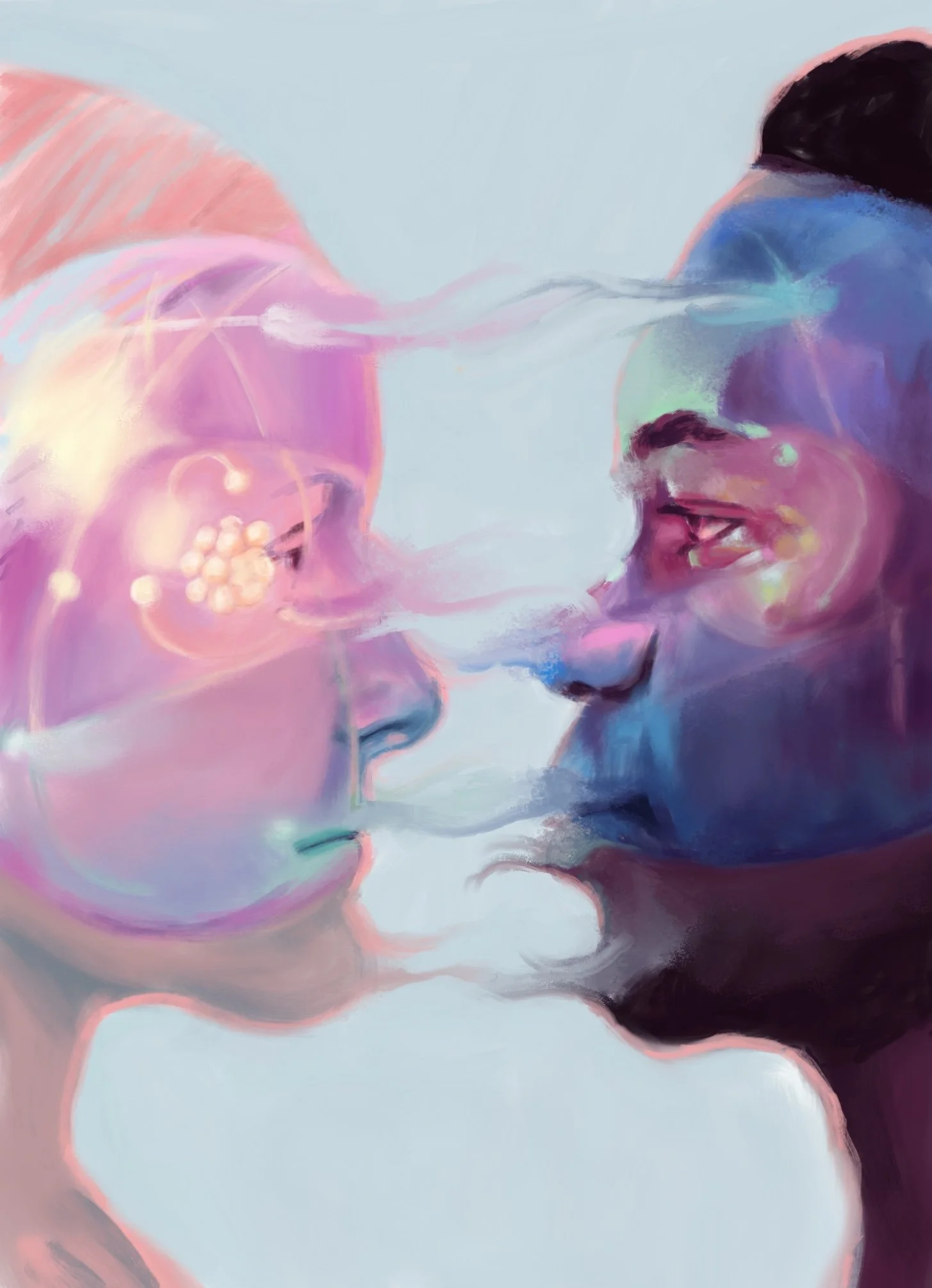
Illustration by Angelica Frausto @nerdybrownkid